
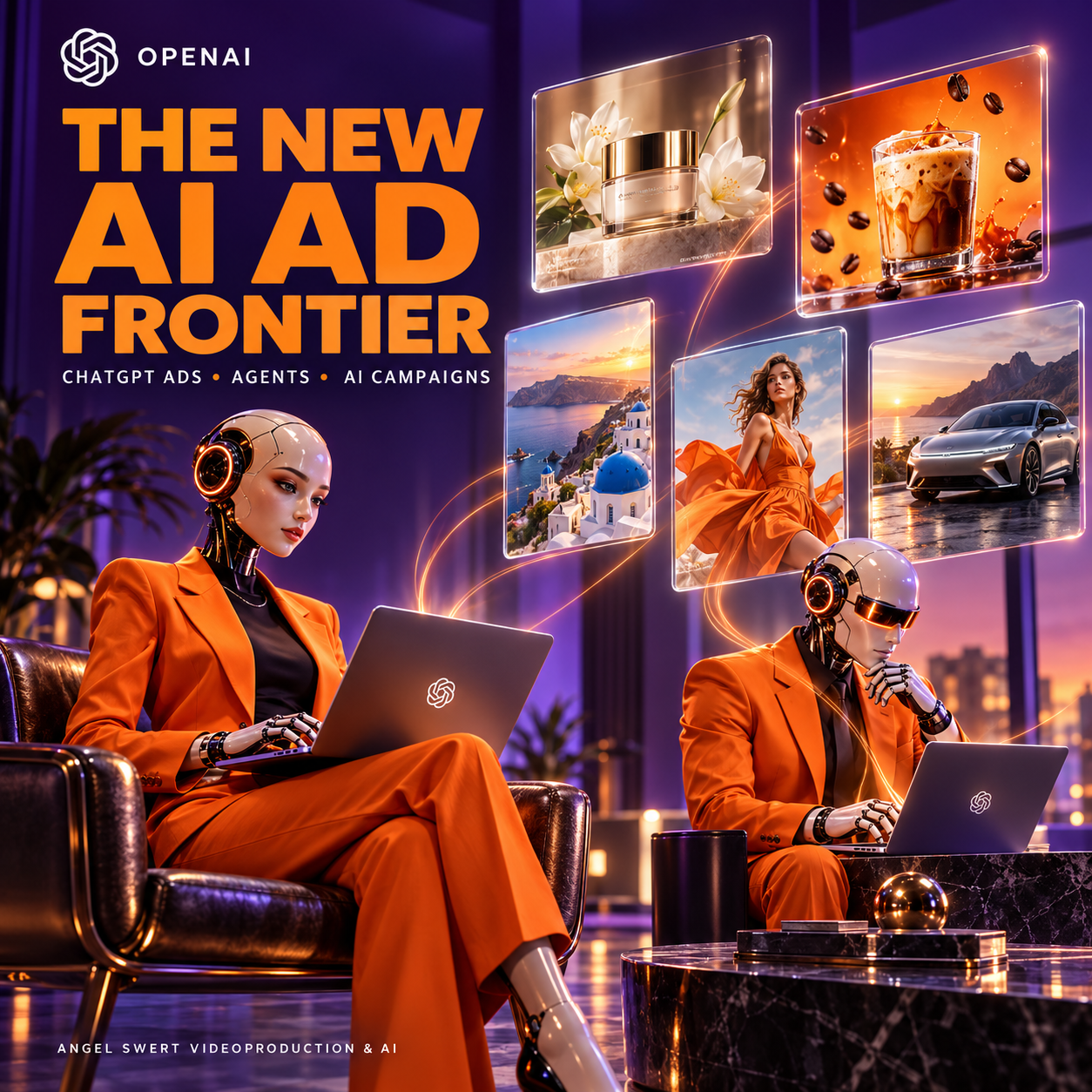
ChatGPT Ads Are Changing: What Businesses Need to Know in 2026
Sponsored Agents, AI campaign tools and the €15 daily minimum—explained for businesses in Germany
ChatGPT Ads in 2026: From Sponsored Placements to AI-Powered Conversations
A customer may see an advert and still have questions.
Will this product fit their needs? How does the service work? What should they compare before making a decision? In traditional advertising, the company usually has to wait for the customer to click through, find the right page and search for those answers.
OpenAI is exploring a different path for advertising in ChatGPT. Its latest updates combine sponsored placements with AI tools that help businesses create and manage campaigns. The company is also testing Sponsored Agents—AI representatives that users can open from an advert to ask questions about a business’s products or services.
This does not mean every company can launch an AI agent in ChatGPT today. Some tools are available to advertisers, while Sponsored Agents remain a limited test. Understanding that difference is the first step for any business considering the channel.
What is changing in ChatGPT Ads?
ChatGPT Ads are paid placements shown separately from ChatGPT’s answers. OpenAI says advertising does not influence the assistant’s independent responses. Advertisers do not receive users’ private chat histories; they receive aggregated campaign information, such as views and clicks.
The bigger change is the context in which an advert can appear. People often use ChatGPT to describe a goal, compare options and work through a decision. That gives advertisers a chance to reach someone while they are exploring a relevant topic, instead of relying only on a short search phrase.
A sponsored placement still needs to be useful. The offer must match the person’s needs, and the landing page should give them a clear next step.
Sponsored Agents: the conversation after the click
Sponsored Agents are designed to let a user start a separate, clearly labelled conversation with an AI representative of a business after clicking an advert. A person could ask questions, explain what they are looking for and follow a link to the company website when ready.
For example, someone considering a training service might ask which course suits their experience. A customer looking at a product might ask about its features or compare different options. In both cases, the agent could help the person explore the offer before they contact the business.
This format could move advertising beyond a single impression or click. It points toward a customer journey where a business can explain its offer through an interactive conversation.
However, Sponsored Agents are not currently open to every advertiser. OpenAI describes them as a limited alpha with selected advertisers and says it is not accepting early-access requests. For businesses in Germany, this is a signal of where the platform may be heading—not a feature they can currently add to any campaign.
AI assistance for campaign creation
Other parts of the update focus on the work advertisers do behind the scenes. OpenAI says businesses can use natural-language prompts with the Ads Manager plugin to create, update and analyse campaigns. A company may be able to start with a website or campaign brief, then ask for ideas or performance recommendations.
Ads Manager can also suggest advertising copy and images based on a landing page and campaign objective. Advertisers can review and edit the suggestions before using them. An optional text-customisation feature can adapt existing headlines and descriptions to the context of a conversation and translate copy into a user’s preferred language.
These tools may help reduce repetitive production work. They do not replace human review. A business still needs to check that its claims are accurate, the language sounds natural and the advert reflects the actual service.
HubSpot and Shopify integrations
OpenAI is also connecting ChatGPT Ads with existing marketing tools. Businesses using HubSpot can connect an ad account, create campaigns, review results and follow up on leads in their CRM workflow.
The initial Shopify announcement focused on US-based merchants, whose product catalogues can be used to create and manage campaigns. Availability may vary by country and account, so businesses should check the current options in their own workspace.
The wider idea is straightforward: a new advertising channel should fit into a company’s existing operations. Campaign management, customer information and product data do not need to live in completely separate processes.
What does ChatGPT Ads cost in Germany?
OpenAI’s current campaign guidance lists a minimum daily budget of €15 for accounts billed in euros. This is the campaign budget floor. It is not a fixed cost per click, and it does not guarantee a specific number of visits, leads or sales.
A daily budget is an average over a seven-day period. At a €15 daily budget, the seven-day spending limit is €105. Actual spending may vary from day to day within the limits shown in Ads Manager.
Advertisers can choose different campaign objectives, including paying for impressions or valid clicks. Eligible campaigns can also use conversion optimisation. The right option depends on what the business wants to measure: visibility, website visits or a defined conversion action.
OpenAI notes that ChatGPT Ads is still developing and that reliable performance benchmarks are not yet available across industries and campaign types. A small campaign can help a business learn how the channel delivers and how its audience responds. It should be treated as a test, not as a guaranteed source of customers.
Germany is listed as available for self-service Ads Manager. The legal entity responsible for advertising and billing must be based in a supported country.
What should businesses do now?
A business does not need to build a complex AI funnel just because a new format has been announced. A practical starting point is to answer a few basic questions:
- What offer do we want to promote?
- What problem or decision does it help with?
- What would a potential customer ask before taking the next step?
- Does our landing page answer those questions clearly?
- What result would make a small campaign worth testing?
These questions matter whether the company uses a standard sponsored placement today or prepares for more conversational formats later.
For businesses working across languages, the update also reinforces the need for consistent content. A translated headline alone is not a multilingual customer experience. The offer, explanation, video, follow-up and next step all need to work in the intended language.
How Angel Swert can help
At Angel Swert Videoproduction & AI, we look at advertising as part of a wider communication system: strategy, Digital Humans, video content, localisation, approval, distribution and measurement.
That perspective can help businesses decide which updates deserve attention now and which remain experimental. It can also help connect campaign messaging with practical materials—such as a concise explainer video, multilingual content or a Digital Human-led presentation.
You do not need to spend hours following every product announcement or trying to translate platform news into a business plan on your own. Contact Angel Swert for a focused ChatGPT Ads review. I can explain what is available, what remains in testing and which next steps make sense for your company.